
Introduction
Product presentation is about more than just aesthetics—it plays a crucial role in attracting customers and making products memorable.
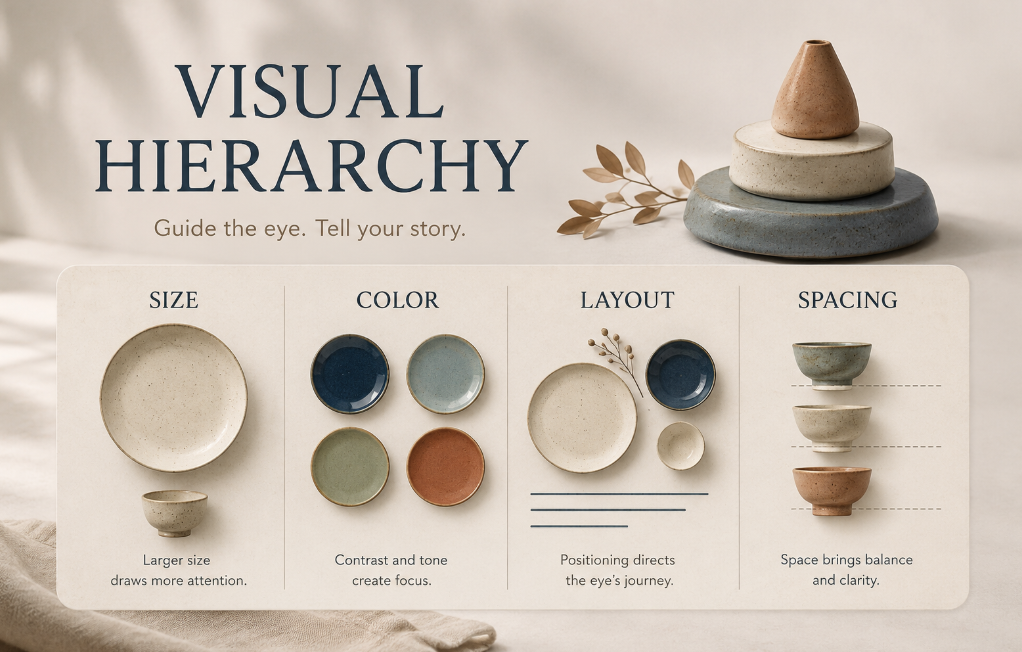
Whether you’re creating product photography for a website, designing a showroom, or producing content for social media, applying the principles of Visual Hierarchy helps guide the viewer’s attention. It ensures that your key products stand out while maintaining balance and harmony throughout the composition.
In this article, we’ll explore the three essential elements of Visual Hierarchy—Hero Products, Secondary Products, and Background Products—and explain how to use them effectively to create professional product displays and compelling visual content.

💡 What is Visual Hierarchy?
Visual Hierarchy is the principle of arranging elements within an image so that viewers naturally focus on the most important object first before moving on to supporting details.
A well-structured visual hierarchy allows an image to communicate its message within seconds while creating a clean, organized, and professional appearance.
In product photography and merchandising, Visual Hierarchy is commonly divided into three categories:
- Hero Products
- Secondary Products
- Background Products
⭐ 1. Hero Products
A Hero Product is the primary focal point of an image—the first product that captures the viewer’s attention.
It is typically the product a brand wants to promote the most, such as a new collection, best-selling item, or signature design.


Characteristics of Hero Products
- Positioned in the most prominent location
- Largest item in the composition
- Receives the strongest lighting
- Sharpest and most detailed object
- Serves as the main focal point of the image
⭐ 2. Secondary Products
Secondary Products support the Hero Product and help tell a more complete visual story.
Although they play an important role, they should never compete with the Hero Product for attention.


Characteristics of Secondary Products
- Smaller than the Hero Product
- Positioned beside or behind the Hero Product
- Complement the overall color palette and design
- Demonstrate how products can be used together
⭐ 3. Background Products
Background Products are supporting elements that create atmosphere and add depth to the composition.
While they are not the main focus, they help complete the overall visual presentation and make the scene feel more natural and inviting.


Characteristics of Background Products
- Positioned in the background
- Often smaller or slightly out of focus
- Do not distract from the Hero Product
- Enhance the overall story and ambiance
💡 Tips for Creating an Effective Visual Hierarchy
Beyond selecting the right products, several design techniques can help strengthen your visual hierarchy:
- Scale – Make the Hero Product the largest object.
- Lighting – Use lighting to naturally highlight the main product.
- Color Contrast – Create contrast so the Hero Product stands out.
- Depth of Field – Use selective focus to separate the Hero Product from the background.
- White Space – Leave enough negative space to prevent the composition from feeling cluttered.
🍽️ Applying Visual Hierarchy to a Ceramic Showroom
A well-designed ceramic showroom shouldn’t try to make every product stand out equally. Instead, it should use Visual Hierarchy to guide customers through the display, helping them focus on featured products first before exploring supporting items.
⭐ Hero Products
Place your featured collections in highly visible locations, such as the showroom entrance, center display tables, or eye-level shelving.
These should include products you want customers to notice immediately.


Examples
- Main dinnerware collections
- Newly launched tableware
- Fine dining collections
- Best-selling signature products
⭐ Secondary Products
Arrange complementary products around the Hero Product to help customers visualize complete table settings and encourage additional purchases.


Examples
- Coffee mugs
- Dessert plates
- Milk pitchers
⭐ Background Products
Use decorative objects and supporting products to create a warm and inviting showroom atmosphere without drawing attention away from the featured collection.


Examples
- Flower vases
- Plates or bowls displayed on rear shelves
- Candle holders
✨ Conclusion
Visual Hierarchy is the art of organizing visual elements so that viewers naturally understand where to look first. By structuring your display with Hero Products as the primary focus, Secondary Products as supporting elements, and Background Products to enhance the overall atmosphere, you can create product presentations that are both visually appealing and highly effective.
Whether you’re styling a ceramic showroom, photographing products for an online store, designing a catalog, or creating content for social media, applying Visual Hierarchy helps communicate your brand more clearly, elevate the perceived value of your products, and create a more memorable experience for your customers.
Leave a Reply