
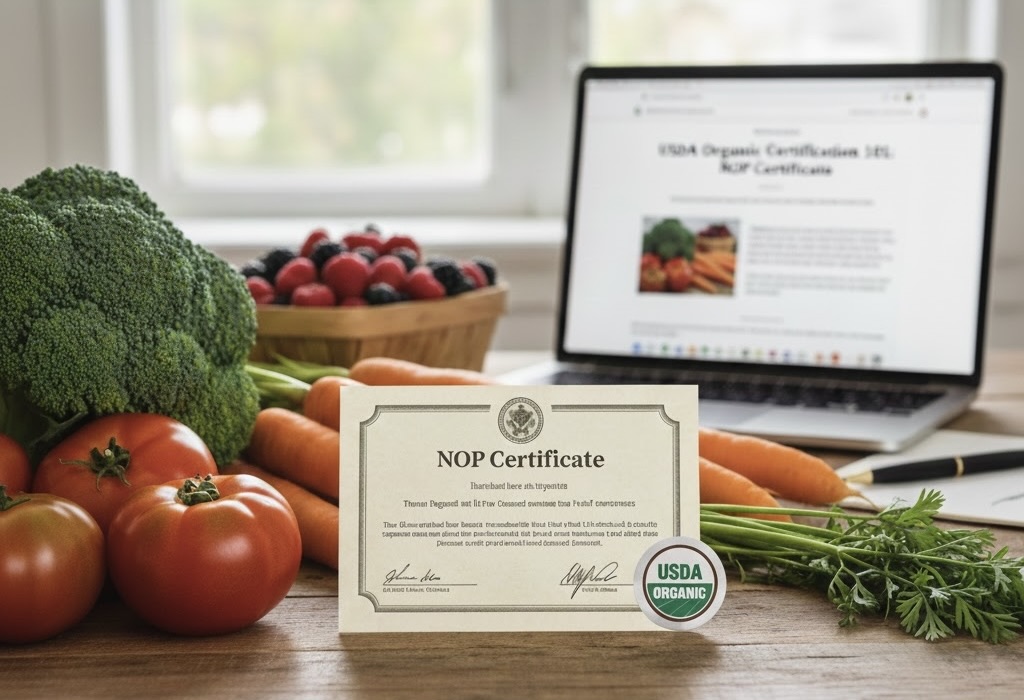

USDA Organic Certification: Do You Need an NOP Certificate?
Introduction
In today’s competitive global food market, simply labeling a product as “organic” isn’t enough. Do you target the lucrative United States consumer base? If so, one critical credential stands above the rest: the National Organic Program (NOP) Certificate. To sell organic food in the US, understanding the NOP is mandatory for producers, processors, and handlers. This certificate is your official passport to the American organic shelves. It ensures your operation meets the highest federal standards for quality and integrity.
What is the NOP Certificate and Why is it Essential?
This certificate is formal proof of compliance. It confirms that a product, farm, or handling facility adheres to the rigorous standards set by the NOP. This USDA federal regulatory program maintains the consistency and integrity of all “organic” products marketed across the US.
- The Gold Standard: Achieving NOP certification allows you to use the coveted USDA Organic Seal. This seal is the consumer’s assurance that the product adheres to strict requirements regarding soil quality, pest control, animal raising practices, and the use of inputs.
- Key Restrictions: NOP standards strictly prohibit the use of genetically modified organisms (GMOs), sewage sludge, most synthetic fertilizers and pesticides, and ionizing radiation. This dedication to purity is what defines the NOP standard.
- Preventing Fraud: The certificate, coupled with the USDA’s recent Strengthening Organic Enforcement (SOE) rule, works to prevent organic fraud, giving buyers confidence that your NOP-certified products are authentic from farm to table.
Who Issues the NOP Certificate?

This is a common point of confusion. The NOP Certificate is not issued directly by the USDA. Instead, the process is decentralized and managed by accredited third parties:
- USDA Accreditation: The USDA first accredits independent, third-party organizations called Certifying Agents globally. These agents are rigorously vetted to ensure they can accurately audit compliance.
- Inspection and Certification: These accredited Certifying Agents (such as QAI, Ecocert, and various regional organizations) are the ones who conduct on-site inspections, review documentation, and ultimately issue the NOP Certificate to compliant operations. They perform annual audits to maintain the integrity of the certification.
Crucial Update: The NOP Import Certificate: Under the new SOE(Strengthening Organic Enforcement) rule, nearly all organic products imported into the US now require an NOP Import Certificate (issued by the exporting country’s Certifying Agent). This ensures enhanced traceability across international borders, making the NOP Certificate more critical than ever for global suppliers.
The Next Step for Global Organic Sellers
If your goal is to tap into the massive American organic market, obtaining NOP certification is a non-negotiable step. The process demands meticulous record-keeping and a full commitment to sustainable practices. Begin by researching USDA-accredited Certifying Agents that operate in your region. They will guide you through the application, inspection, and compliance process to ensure you successfully obtain your NOP Certificate.
Leave a Reply