
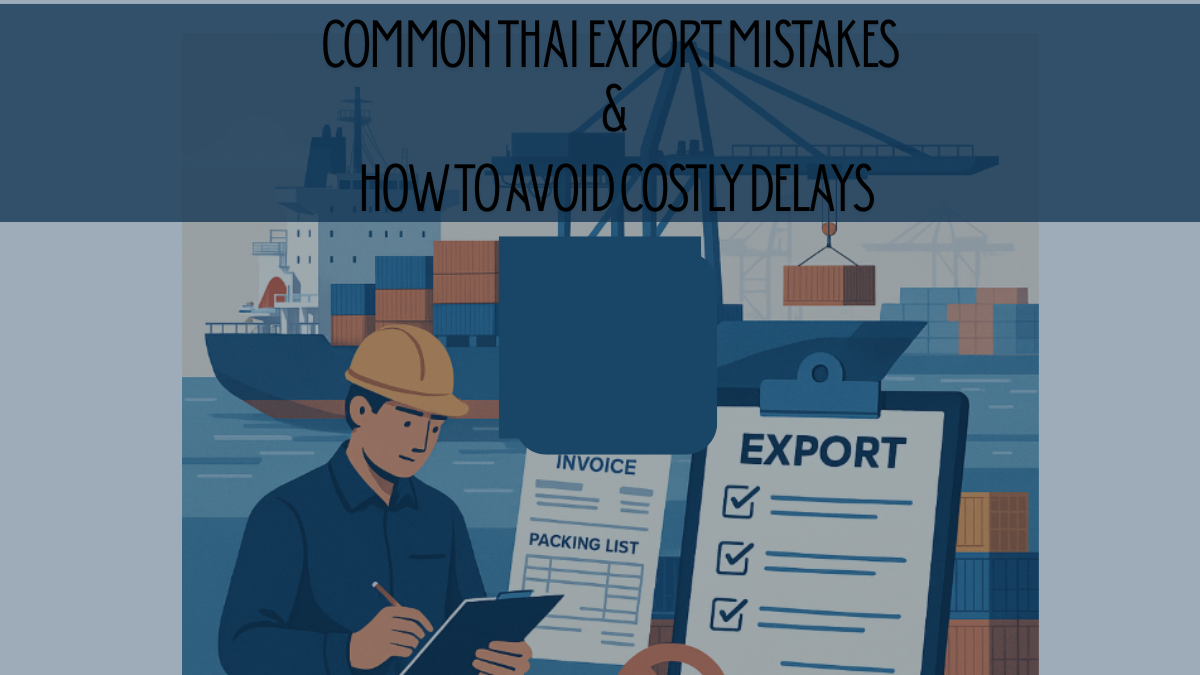
Exporting from Thailand offers massive opportunities — especially for brands expanding into markets like the United States. However, many Thai exporters still face repeated shipping delays, customs hold, and unnecessary costs simply because of avoidable mistakes.
The most common export mistakes and how you can avoid costly delays.

1.Incomplete Export Documentation
One of the top reasons for export delays is missing or incorrect paperwork.
Essential documents such as the Commercial Invoice, Packing List, Export Declaration (EX-1), Certificate of Origin, and Bill of Lading must be accurate and consistent.
How to avoid it:
✅ Double-check all data (product codes, quantities, weights, and HS codes).
✅ Ensure consistency across all documents — even a small typo can cause customs issues.
✅ Use a document checklist before submission.
2.Incorrect HS Codes & Valuation
Misclassification under the wrong HS (Harmonized System) code can lead to customs inspection, incorrect duties, or product holds.
How to avoid it:
✅ Verify the correct HS code with your freight forwarder or customs broker.
✅ Use official Thai Customs or U.S. HTS databases.
✅ Keep records of product photos, materials, and usage to support classification.
3.Ignoring Importer Requirements (FDA, FSVP, APHIS)
Certain product categories — like food, supplements, ceramics, and natural materials — require U.S. regulatory compliance.
Skipping this step can lead to seizures by the FDA or USDA (APHIS) upon arrival.
How to avoid it:
✅ Verify if your product requires FDA registration, FSVP documentation, or APHIS permits before shipment.
✅ Partner with a U.S.-based IOR (Importer of Record) or compliance agent.
✅ Always label products in English as per destination market standards.
4.Poor Communication with Freight Forwarders
Lack of updates between exporters and freight forwarders often leads to confusion over shipment status, vessel schedules, or document cut-off times.
How to avoid it:
✅ Confirm the ETD (Estimated Time of Departure) and cut-off dates well in advance.
✅ Request real-time tracking updates.
✅ Use a logistics partner who provides transparent communication and shipment visibility.
5.Underestimating Customs Clearance Time
Even if all documents are perfect, clearance can take longer than expected due to random inspections or incomplete product descriptions.
How to avoid it:
✅ Provide clear, detailed product descriptions.
✅ Keep all shipment records accessible for customs inquiries.
✅ Work with an experienced U.S. customs broker.

Final Thoughts
Successful exporting isn’t just about moving goods — it’s about managing time, compliance, and communication.
Avoiding these common Thai export mistakes can save you weeks of delay and thousands of baht in unnecessary costs.
Leave a Reply